
In January 2025, the Eaton and Palisades fire burned more than 37,000 acres across Los Angeles County.
Those two fires destroyed 16,251 structures, damaged 2,047 others and displaced over 200,000 residents across Southern California, according to the County of Los Angeles.
This destruction was recognized by two USC engineering students, committed to making a difference in fire resistance.
Mitchell Kirby, a senior studying civil engineering and pursuing a master’s degree in mechanical engineering, teamed up with Alex Bartolomei, a junior environmental engineering major who is also pursuing a master’s degree in mechanical engineering. They created Ember Corps, an organization focusing on disaster resilience after the disastrous fires of 2025.
“After last year’s wildfires, we really saw a need,” Kirby said. “There was a lack of water, and there were overstrained municipal resources.”
After witnessing the strain placed on local resources during the 2025 wildfires, Kirby and Bartolomei began exploring ways technology could help close gaps.
“There was a lot happening, and not enough to cover the need in such a quick capacity, as we saw with the winds and all the different accelerants,” Kirby said. “So we came together kind of in the past couple of months.”
The Eaton and Palisades fires make up two of the four most destructive wildfires in California history, with the other two, the Camp and Tubbs Fires, being within the last eight years, according to CAL FIRE.
Wildfire risk could become increasingly important as Los Angeles prepares to host major international events, including the 2026 FIFA World Cup and the 2028 Olympic Games.
The main product the duo is building at Ember Corps is called HomeBase, a quick and accessible technological drone tool utilized to respond to fires when they are first spotted to contain the spread shortly after a wildfire is detected.
“There are a lot of ideas that came up, but what we really found is that helping on a municipal government support system level by building assets like drone hubs that can have drones with firefighting capabilities that can carry amounts of fire suppressant and fire retardant to quickly respond to the fire,” Kirby explained.
Both of the engineers have a history with fires, directly contributing to their desire to work on this new project.
Kirby comes from a family where the males are all firefighters except him. Bartolomei has had personal experiences watching the Tubbs fire loom in the sky and the Kincade Fire tear through his hometown.
“That’s why we really kind of focus on this,” Kirby said, “It’s right here. We’re in Los Angeles. It’s the stuff that we see affects our friends, our professors, and everything around us.
Not only did many Altadena residents attest that they were unprepared for the Eaton Fire, but they were also not notified in time, according to Los Angeles Public Press.
“That’s the key part, quick response,” Kirby continued. “Closing the response gap is what HomeBase is doing. When we saw the fires last year at 10:30 in the morning, they were reported, and there were 10 acres. At 11:30 AM, there were 200 acres. So you saw an explosion [multiply by 20] in an hour.”
The engineer duo said that the idea for the drones is to be automated, but that technology will come later. The most important thing is developing the technology to help firefighters help as many people as possible.
The main area HomeBase is targeting is areas of concern, more specifically, areas in the Wildland-Urban Interface (WUI), which is the transition zone where human structures and development meet or are intermixed with wilderness areas and vegetation.
The dry nature of California’s climate brush makes these areas especially flammable, and has been growing by 2 million acres yearly, according to the U.S. Fire Administration.
“It’s not that a home catches on fire and starts a big wildfire,” Bartolomei said. “It’s these brush fires, and when they cross over, from just being brush fires to burning homes, burning infrastructure, and hurting people.”
For Bartolomei, the greatest danger emerges when fires move from undeveloped vegetation into populated communities.
“That’s really kind of the threshold with which that happens,” Bartolomei said. “It is the wildland-urban interface. And so that’s really where, you know, from an infrastructure perspective, a lot of defense efforts are really centered.”
Mapping where WUI areas are across Southern California is an arduous task, and the two know it, they said.
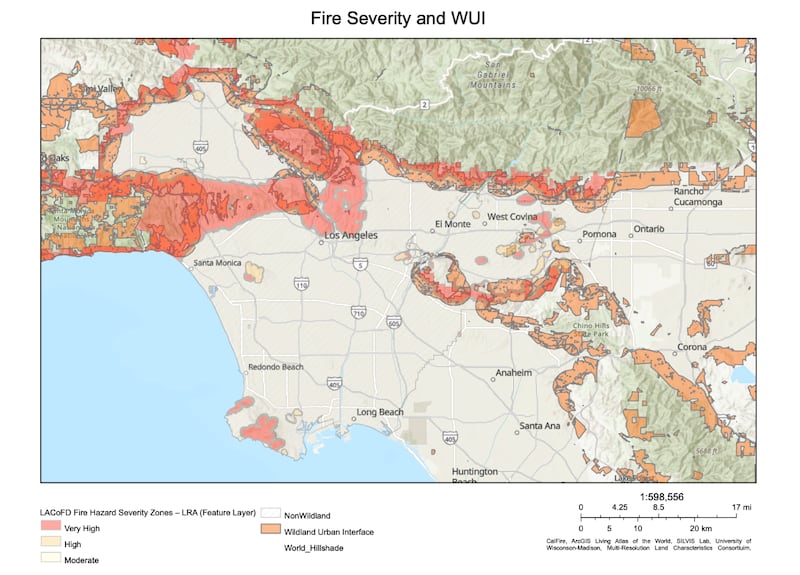
Fortunately, using different mapping tools, specifically Geographic Information System (GIS) mapping, allows for layering of spatial data, as well as census and scientific data of residents, resilience and historical disaster traits, which can help engineers like the founders of Ember Corps and scientists locate areas of concern for future fires.

The following GIS map, which covers the social vulnerability index of the Altadena community and compares it to the area of the Eaton Fire, displays a higher level of communal vulnerability and elevated risk to the flame than neighboring communities found in La Cañada and Pasadena.
“What we’re using to map and a lot of our public source data is coming from people like CAL FIRE,” Kirby said. “They have a great database and different geo mapping to understand where the terrain is a factor, and what we’re considering, of why it deems itself outside of rapid response.”
Both Ember Corps and HomeBase have plans to not only continue working on prototypes for the drone and preview one this summer, but also to continue working deeply within Los Angeles to fully flesh out the design in hopes of getting involved in the action against fire danger, especially during events such as the Olympics.
“A huge part of the LA28 committee is wildfire resilience, because in the middle of July, if you have a wildfire, you have 15 million people in the city, stresses are going to be quite high,” Kirby said. “I mean, it would be just quite a catastrophe if wildfires were not contained. So, we see ourselves as an integration, not just for the Olympics, but for well after them.”
Even with Kirby graduating and with Bartolomei still having one year of his degree left, the two are determined to continue to work on Ember Corps and HomeBase for many years to come.
“We’ve always just been go, go, go. You know, that’s kind of our philosophy. Just got to go, do,” Bartolomei said.
The plan following Kirby’s graduation is simple: develop, plan, adjust.
“Now we’re kind of at the point,” Bartolomei said. “Building out our drone and working with stakeholders to build these long term relationships so that our technology can go and help as many people as possible.”
The current plan for the duo is to prototype their initial design, demonstrate their HomeBase product and business model on a controlled fire to showcase the product’s effectiveness, and then roll out the next steps with possible investors and associates to get the product implemented in Los Angeles.
The duo and their endeavors are one of many that are a part of the need for technological advancements in the combat against wildfires.
Rebecca Harned, Principal Research Scientist at the Fire Safety Research Institute, intensifies the need for products like HomeBase and highlights the important need for more developments like Ember Corps: “Now more than ever, we need to understand the unique strengths of existing and emerging wildfire risk models. To answer this call to action.”
“Hopefully we can build a world where wildfires are no longer the devastating forces that they are today,” Bartolomei said. “Which is a big, big challenge to tackle.”