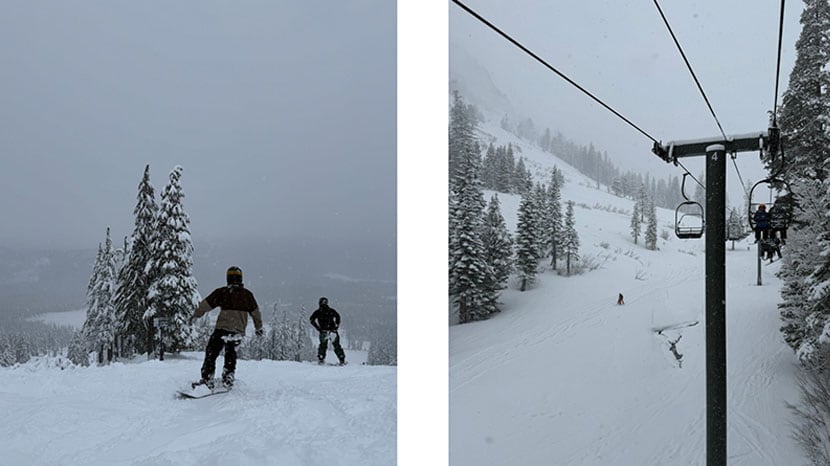
A dangerous snowstorm struck the Tahoe region of California last weekend, causing whiteout conditions with virtually zero visibility, icy roads and increasing chances of an avalanche.
The storm raised challenges for students who are part of two USC clubs — the SoCal Snow Club and the USC Ski & Snowboarding Club — that visit Northern California during the spring semester to enjoy the wintry conditions.
The University of California, Los Angeles (UCLA) and the University of California, San Diego (UCSD) also have similar clubs that often meet up on the weekends, including last weekend.
But with the storm bearing down, many members of the UCSD Snow Club departed their planned trip one night early so they wouldn’t get stuck.
“[Our] president announced a plan accordingly on how to vacate Tahoe safely before the storm hit, as many drivers had little to no experience driving through snow,” said UCSD student Alina Brockway, a snow club member and structural engineering student.
But with the potential for avalanches, how can students with less experience driving in these conditions be better prepared?
Despite visiting snow-spotted mountains regularly, college students at popular California universities fall short in their knowledge of what to do during an avalanche emergency.
Brockway said that she knew very little about avalanche safety despite growing up skiing.
“The main thing I learnt was that most avalanches happen during or soon after a big snowstorm, periods of strong winds, or during a thaw,” Brockway said. “I always keep that in the back of my head when heading up to the mountain by checking the weather forecast and planning my trip accordingly.”
News had emerged that by Tuesday, at least 15 backcountry skiers between the ages of 30 and 55 had been caught in an avalanche near Castle Peak. Eight skiers died, and a ninth skier remained missing as of Thursday.
“It is really sad to hear… [skiing] is fun and there is nothing better than a powder day, but it can [definitely] be dangerous at times,” said USC sophomore Sophia Roberts, “Avalanche deaths and accidents are very sad to hear about, and it definitely serves as a warning that this kind of tragedy is possible with what we love to do.”
Brockway also said that she was taught to never ski alone and to have a good understanding of the terrain, including the steepness, connections, and potential traps like rocks and gullies.
Ugne Koveraite, a junior and neuroscience major who is involved in USC Ski and Snowboarding, echoed the sentiment.
“Always ski with a buddy, don’t go near tree wells, and [always] let someone know what your plan is,” Koveraite said.
The National Weather Service recommends that those skiing in avalanche-prone areas have a transceiver, shovel and probe in their packs. Other recommendations include having a fully-charged phone and a paper trail map.
Avalanche safety is something all skiers should know, especially college students and younger skiers who don’t have as much experience in adverse conditions.
According to the Federal Emergency Management Agency, an average of 28 people die in avalanches every winter in the U.S., but there are precautions people can take to mitigate this risk.
Another severe weather event occurred on the West Coast Tuesday, when the first winter snowfall impacted the area of Reno, Nevada. As a result, the University of Nevada, Reno postponed all synchronous classes and activities on campus.
According to Thomas Albright, deputy state climatologist at the Nevada State Climate Office, the storm caused disruption.
“I will say that after 16 years of living here, I’m pretty sure this is the first time the university has been closed for snow on three consecutive days” said Albright. “The school district closed schools two days in a row and, [on Thursday], opened [schools] with a delay.”
Students can look to relevant weather organizations like the Nevada State Climate Office for emerging news, research, and initiatives related to snow and wintry storms, according to Albright.